
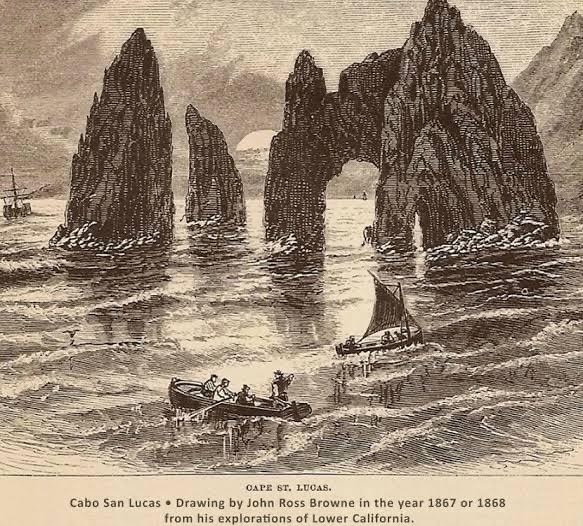
Cabo San Lucas, at the southern tip of the Baja California peninsula, is famous for its beaches, the Arch and its nightlife. But behind the resorts lies a story of Indigenous peoples, treasure-laden galleons, pirates and a small fishing village that became one of Mexico’s best-known destinations.
The Pericú, the first inhabitants
Long before Europeans arrived, the Cape region was home to the Pericú people, who lived from fishing, gathering and hunting. According to the Los Cabos tourism office, they called this place Yenekamú. The most detailed accounts of them were left by English sailors who stopped in Cabo San Lucas in the early 1700s.
Manila galleons and pirates in the bay
After Spain reached the Philippines, the Manila Galleon crossed the Pacific loaded with silk, porcelain and spices, and the tip of Baja California was its first landmark in the Americas. That attracted English privateers.
- 1587: privateer Thomas Cavendish captured the galleon Santa Ana in Cabo San Lucas bay after a battle lasting hours — one of the richest prizes of the era.
- 1602: Sebastián Vizcaíno’s expedition explored and mapped this coast.
- 1709: Woodes Rogers captured another galleon in the same bay. On board was Alexander Selkirk, the castaway who inspired Robinson Crusoe.
Today, on the pirate ship sunset cruise you can relive some of that history while sailing past the Arch.
The tuna cannery and the fishing village
For much of the 20th century, Cabo San Lucas was a small town built around its tuna cannery, established on land in 1927 and once one of the most important in Latin America. Read more in the history of the Cabo San Lucas tuna cannery.
From village to world-class destination
In the 1950s and 60s the first fly-in hotels for sport fishermen opened. In the 1970s the federal government pushed development, and the name Los Cabos was coined for Cabo San Lucas, San José del Cabo and the corridor between them. Hotel Finisterra opened by Land’s End in 1971, and the municipality of Los Cabos was created in 1981.
The Transpeninsular Highway, the marina and the international airport completed the shift from fishing to tourism. Sportfishing is still part of Cabo’s identity: every October the town hosts the Bisbee’s Black & Blue, one of the richest tournaments in the world.
Places to discover Cabo’s history
- The Arch and Land’s End: where navigators recognized the end of the peninsula. See it on a glass-bottom boat tour.
- The marina entrance, where remains of the old cannery still stand.
- San Lucas Church, in the heart of town.
- San José del Cabo, with its mission founded in 1730 and its historic center.
Explore Los Cabos with our tours
FAQ
Who were the first inhabitants of Cabo San Lucas?
The Pericú, an Indigenous people who lived in the Cape region mainly from fishing and gathering.
Why were there pirates in Cabo San Lucas?
Because galleons from Manila passed the tip of Baja California. Privateers like Thomas Cavendish (1587) and Woodes Rogers (1709) waited here to attack them.
When did Cabo San Lucas become a tourist destination?
The first hotels opened in the mid-20th century, but major development began in the 1970s; the municipality of Los Cabos was created in 1981.